
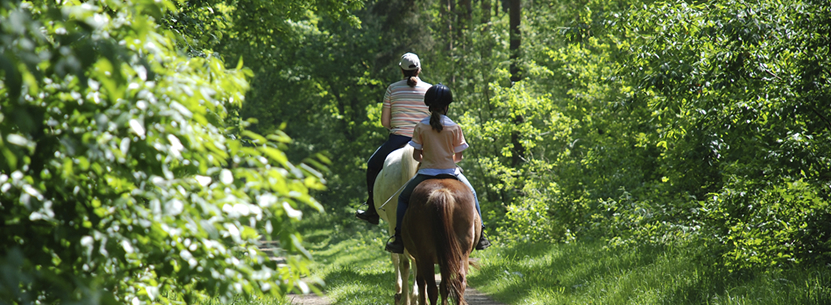
Horse riding and trekking in Meath
County Meath is horse country. Its rolling farmland, quiet lanes and long equestrian tradition make it a natural place to ride, whether you live locally or are visiting from Dublin for the day. This guide explains what trekking and hacking involve, what to expect as a beginner or returning rider, and how to stay safe riding out in Meath.
Trekking, hacking and lessons: what is the difference?
- Lessons take place in an arena with an instructor teaching you specific skills.
- Hacking means riding out, usually on lanes, tracks or fields, at walk, trot and sometimes canter, in a small supervised group.
- Trekking in Ireland usually refers to a guided ride out at a steady pace, mostly walk, often aimed at beginners or holiday riders, sometimes lasting an hour or more.
Many riding schools in Meath offer a mix. If you are new to riding, a couple of arena lessons before a trek will make the ride far more enjoyable. Our guide to your first riding lesson explains what to expect.
Who can go trekking?
Centres set their own rules, but common conditions are:
- Minimum age, often around eight to ten for treks outside the arena, with younger children sometimes offered short led rides.
- Weight limits for the welfare of the horses. Ask in advance and answer honestly; centres match riders to horses by size and weight.
- Ability: beginner treks are usually at walk. Faster rides with trot and canter are generally for riders who can already rise to the trot and stop reliably.
Riding in Meath: the landscape
Meath is largely low-lying, with gently rolling pasture, hedgerows and the river valleys of the Boyne and Blackwater. Much riding out happens on quiet country roads and lanes, farm tracks and private land with the landowner's permission. There are few large open upland areas of the kind found in Wicklow or the west, so rides in Meath tend to be about green lanes, woodland edges and countryside views rather than mountain trails.
Many of the county's best-known heritage sites, such as the Hill of Tara and the Brú na Bóinne monuments, are protected places where riding is not permitted. Enjoy them on foot instead.
Safety on Meath's roads and lanes
Because so much riding out uses public roads, road safety matters:
- Wear high-visibility clothing, for horse and rider, in all weather. Drivers see hi-vis far sooner, especially on bends and in Irish grey light.
- Ride in single file on narrow roads, and follow the guide's instructions about where to ride and when to pull in.
- Thank drivers who slow down; it encourages good behaviour.
- Never ride on roads after dark without proper lights and reflective equipment, and preferably not at all.
The Road Safety Authority publishes advice for horse riders on using public roads.
What to wear for a trek
- A riding hat to a current safety standard; most centres lend them. See our riding hat standards guide.
- Boots with a small heel.
- Comfortable trousers without thick inside seams.
- Layers and a waterproof; the weather on a ninety-minute ride can change more than once.
- Gloves.
- A body protector is often recommended or required for faster rides. Our body protector guide explains the levels.
More detail is in what to wear horse riding.
Choosing a riding or trekking centre
- Look for AIRE approval. The Association of Irish Riding Establishments approves riding, trekking and facility centres and inspects members regularly.
- Ask about group size and how many guides go out with each group.
- Ask how they assess ability, especially for faster rides.
- Check what happens in bad weather and whether rides are cancelled or moved to the arena.
- Look at the horses. Calm, well-kept horses in good condition are the best sign of a well-run yard.
Combining a ride with a day out
Meath's heritage towns make a good base for a day of riding and sightseeing. Trim, with its castle, is close to the centre of the county, and the Boyne Valley's monuments are within easy reach. The location page describes where Summerhill sits relative to Trim and Dublin.
Getting the most from a ride out
A few habits make a trek more comfortable and safer for everyone in the group:
- Arrive early so there is time to be matched to a horse, have your stirrups adjusted and ask questions before setting off.
- Keep a horse's length between you and the horse in front. Horses can kick if crowded, and the gap gives you time to react if the group stops.
- Do not let the horse graze on the move. Keep a light, steady contact and use your legs to keep walking.
- Speak up early if you feel uncomfortable, the stirrups feel wrong or you would like to slow down. Guides would much rather adjust things at the start than deal with a tired or nervous rider later.
- Look up and ahead. Looking down at the horse's neck tips your weight forward and makes it harder to balance.
After the ride, expect some stiffness in the knees and inner thighs if you are not used to longer sessions in the saddle. A short walk and a gentle stretch help.
Frequently asked questions
Can complete beginners go trekking?
Often yes, on walk-only treks with quiet horses. Booking one or two arena lessons first will make you more comfortable and safer.
How long is a typical trek?
Many centres offer rides of around one hour, with longer options for experienced riders. Check with the centre.
Is there a weight limit for trekking?
Most centres have one for the welfare of their horses. It varies with the horses available, so ask when booking.
Do I need to bring my own hat?
Most centres lend riding hats. If you bring your own, it should meet a current safety standard and fit properly.